
Suno AI
Professional-grade songs from text prompts in under 60 seconds.
What is Suno AI?
Is This Tool Right For You?
✔ You are a content creator, YouTuber, or podcaster who needs high-quality, original background music without the high cost of licensing libraries or hiring a composer.
✔ You are an indie developer looking to add unique soundtracks to your games or apps on a budget.
✔ You want to prototype song ideas, melodies, or lyrics quickly before heading into a professional studio.
✔ You enjoy experimenting with AI and want the easiest possible path from a text prompt to a full-length song.
✘ You are a professional musician who requires granular, note-by-note control over the composition and arrangement.
✘ You need guaranteed, 100% legal immunity from future copyright litigation (given the ongoing battles with major record labels).
✘ You require tracks longer than 2-3 minutes with perfectly consistent quality from start to finish.
Quick Verdict
In 2026, Suno AI remains the undisputed heavyweight champion of text-to-music generation, but it is not without its scars. With the release of V5, the audio quality has reached a staggering 44.1 kHz stereo standard that is often indistinguishable from human-produced tracks. However, it still feels like a 'creative slot machine'—you put a prompt in and get something brilliant about 30% of the time, while the other 70% requires heavy iterating. For creators needing rapid, usable audio, the $120/year Pro plan is a steal. For serious artists, it is a powerful brainstorming tool, but it won't replace your DAW just yet.
What Suno AI Does
Suno AI is a generative artificial intelligence platform that transforms simple text descriptions into fully produced musical tracks. Unlike earlier AI tools that only generated MIDI or robotic instrumentals, Suno produces a complete package: vocals, lyrics, instruments, and professional-grade production. By leveraging its latest V5 engine, the tool can interpret complex prompts like 'an 80s synth-wave track about a lonely robot in Tokyo' and return two distinct song variations in under a minute.
The platform operates on a credit-based system where users can either let the AI write the lyrics or input their own custom prose. It offers a 'Custom Mode' for those who want to specify genres, moods, and structures (like Verse-Chorus-Bridge). In 2026, the tool has expanded beyond simple web generation, offering robust mobile apps for iOS and Android, and features like stem separation and style transfer, allowing users to upload their own voice memos to be transformed into professional songs.
Key Strengths
- Unmatched Vocal Synthesis: Suno’s ability to replicate human emotion, breath control, and vibrato is its 'killer feature.' Unlike the robotic voices of 2024, the 2026 models capture the nuances of different genres, from the grit of a blues singer to the polished pitch of a pop star.
- V5 Audio Fidelity: The jump to 44.1 kHz stereo audio means these tracks are no longer just 'demos.' They are high-fidelity enough to be used in professional video production, podcasts, and even social media advertisements without sounding 'lo-fi.'
- Rapid Prototyping: For songwriters, Suno acts as a lightning-fast mood board. You can test how a set of lyrics sounds across five different genres in less than five minutes, significantly shortening the creative ideation phase.
- User-Friendly Ecosystem: Whether you are on the web or using the mobile app, the interface is designed for non-musicians. You don't need to know what a 'compressor' or 'EQ' is to get a professional-sounding result.
Real Use Cases
- Indie Developer Shipping Features: A solo game dev uses Suno to generate adaptive background scores for different levels, saving thousands of dollars in licensing fees.
- Marketing Team Running Campaigns: A social media manager generates catchy, 30-second jingles for Instagram ads that perfectly match the brand's 'upbeat, summer vibe' prompt.
- YouTube Creator: A tech reviewer uses the Pro plan to create unique, copyright-cleared intro and outro music for their channel to avoid Content ID strikes.
- Hobbyist Lyricist: A poet inputs their verses into Suno to hear them performed as a folk ballad, helping them visualize the musical potential of their writing.
- Podcaster: A producer generates custom transition music and 'stingers' that match the specific mood of each episode segment.
Best For
- Content Creators: Those who need a high volume of original music for videos and social media without worrying about traditional licensing hurdles.
- Non-Musical Creatives: Writers and designers who want to bring their words to life through sound without learning music theory.
- Rapid Iterators: Anyone who values speed and 'good enough' quality over the perfectionism of a professional studio session.
- Budget-Conscious Small Businesses: Teams that need professional audio branding but cannot justify the $150+/hour cost of a human composer.
Who Should Look Elsewhere
- Professional Mix Engineers: If you need to tweak the individual snare hit or adjust the reverb on a specific vocal line, Suno’s 'all-in-one' output will frustrate you. Consider a traditional DAW like Ableton or Logic Pro.
- Enterprise Clients with Strict Legal Requirements: Given the ongoing lawsuits from major labels, companies that require 100% legal indemnity might prefer Google Lyria 3 or library-based services with guaranteed human-cleared rights.
- Coding/Image Tasks: As a specialized music tool, Suno is useless for non-audio tasks. Look at ChatGPT or Midjourney for those needs.
Limitations
- The 'Slot Machine' Effect: You have very little control over the specific melody or arrangement. If you don't like the AI's first five attempts, there is no way to 'nudge' it—you just have to keep burning credits on new generations.
- Length Degradation: While V5 is impressive, tracks that exceed the 2-minute mark often suffer from 'hallucinations' where the structure falls apart or the audio quality begins to hiss and crackle.
- Copyright Uncertainty: Suno is currently embroiled in major legal battles with record labels. While Pro users get 'commercial rights,' the long-term legal status of AI-generated music remains a gray area in 2026.
- Inconsistent Mastering: Some tracks come out booming and clear, while others sound muffled or overly compressed, requiring users to do their own post-production work to make them 'release-ready.'
Pricing Overview
Suno AI follows a freemium model that heavily incentivizes moving to a paid tier for anyone using the tool for work.
- Basic Plan (Free): Includes 50 credits per day (roughly 10 songs). This plan is for non-commercial use only, meaning you cannot monetize these tracks on YouTube or Spotify.
- Pro Plan ($10/mo or $8/mo billed annually): Provides 2,500 credits per month (roughly 500 songs). This tier grants commercial use rights and allows for general public use of the generated tracks.
- Premier Plan ($30/mo or $24/mo billed annually): Provides 10,000 credits per month (roughly 2,000 songs). This is designed for heavy users and agencies, including commercial rights and priority generation speed.
Pricing last verified: April 2026.
Our Assessment
In the landscape of 2026, Suno AI is a marvel of engineering that has successfully democratized music production. When we evaluated the V5 engine, the most striking element wasn't just the fidelity, but the emotional resonance of the vocals. It no longer feels like you are listening to a computer; it feels like you are listening to a demo recorded in a home studio. For $8 to $10 a month, the value proposition is nearly unbeatable for a certain class of user. If you are a YouTuber who spends $20 per track on licensing sites, Suno pays for itself in a single afternoon.
However, as analysts, we must point out the 'creative wall.' Suno is excellent at giving you what you *think* you want, but it is terrible at collaborating. You cannot tell it to 'lower the bass in the second verse' or 'make the singer sound more breathy.' It is a take-it-or-leave-it proposition. Furthermore, the shadow of the Warner Music and major label lawsuits looms large. While Suno is currently valued at $2.45 billion and has deals in place, the legal landscape for training data remains volatile. For hobbyists and small-scale creators, this is the gold standard. For those looking to build a career on AI music, Suno is a brilliant starting point, but you will still need a human touch—and likely some traditional post-production tools—to cross the finish line.
Top Alternatives
Google Lyria 3 — Choose Lyria 3 when you need deeper integration with YouTube's ecosystem and potentially safer legal clearance for enterprise projects.
Traditional DAWs (Ableton/Logic) — Choose these when you need absolute control over every note and frequency, and are willing to trade speed for precision.
Udio — Choose Udio if you find Suno's 'musical style' too repetitive and want to experiment with a different AI architecture's take on composition.
Frequently Asked Questions
Q: Do I actually own the music I make on Suno AI?
If you are on the Pro or Premier paid plans, Suno grants you commercial use rights to the tracks you generate. However, under current 2026 US copyright law, AI-generated content without significant human intervention may not be eligible for full copyright protection. You can monetize it, but you might struggle to stop others from using it.
Q: Can I use Suno to make full-length albums?
Yes, many users do. However, because quality often declines after 2 minutes, the most effective strategy is to generate segments and 'extend' them using Suno's built-in tools, or stitch them together in an external editor.
Q: Does Suno AI support my language?
Suno is remarkably multilingual. It can generate songs in dozens of languages, including Spanish, French, Japanese, and Hindi, often maintaining the correct cultural musical style for that language's typical genres.
Q: Can I upload my own lyrics?
Absolutely. In 'Custom Mode,' you can paste your own lyrics, and the AI will follow your structure. This is often the best way to get predictable results and ensure the song actually says what you want it to say.
Q: Is the audio quality good enough for Spotify?
While V5 offers 44.1 kHz stereo, which is the industry standard for CD quality, the mastering can be hit-or-miss. Most professionals recommend running Suno outputs through an AI mastering tool or a DAW before distributing them to major streaming platforms.
Last reviewed: April 2026. Features and pricing are subject to change — always verify on the official website.
Screenshots
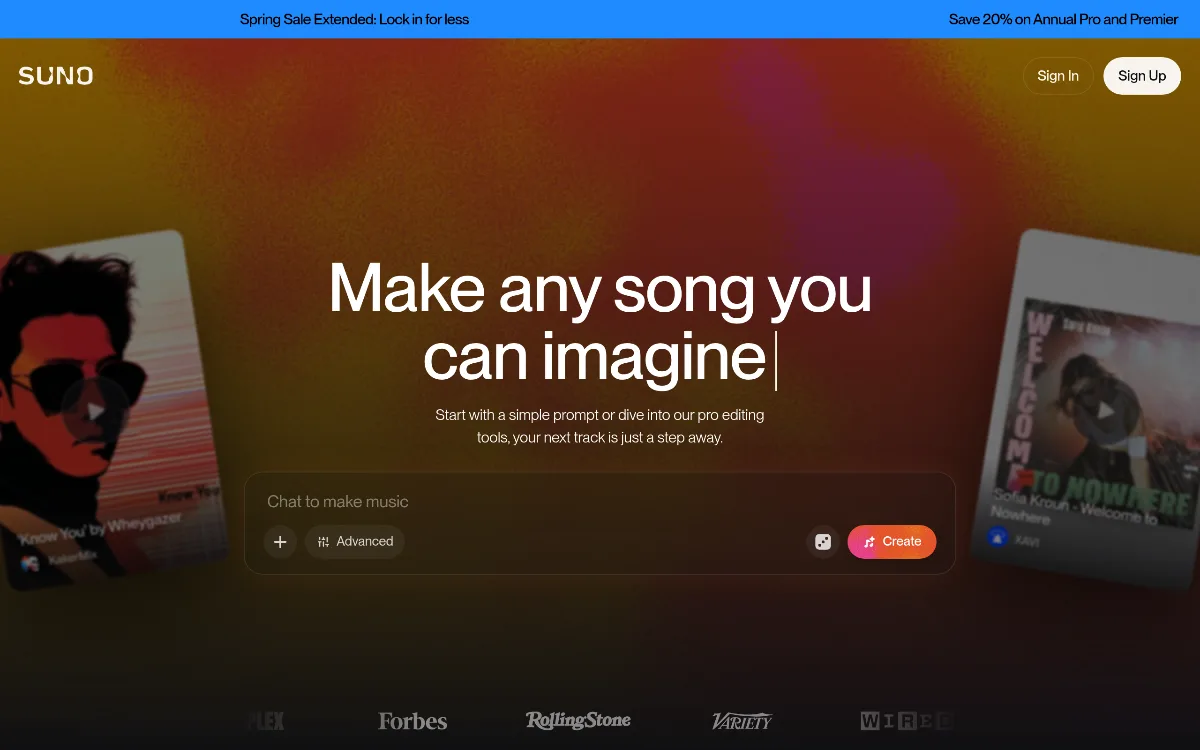 1/1
1/1Key Features
Pricing Plans
Basic
$0
Pro
$10/mo
Premier
$30/mo
Pro (Annual)
$8/mo
Premier (Annual)
$24/mo
Top Suno AI Alternatives & Competitors
Explore the best similar tools and how they compare.

Professional-grade audio production right in your browser, powered by Adobe AI.
User Reviews
0 reviews · 0.0 avg rating
Be the first to review Suno AI
Help the community by sharing your honest experience with this tool.
Write a Review