
Dovetail
Turn scattered customer feedback into actionable roadmap opportunities with AI.
What is Dovetail?
Is This Tool Right For You?
Finding the right customer intelligence platform is a high-stakes decision for product teams in 2026. Here is the honest breakdown of who Dovetail is built for:
- ✅ UX Researchers and Product Managers who are currently drowning in a sea of Zoom recordings, Slack messages, and survey exports.
- ✅ Scale-ups and Enterprises that need a SOC 2 Type II and HIPAA-compliant repository to store sensitive customer data.
- ✅ Teams looking to ship faster — Dovetail specifically claims a 66% increase in shipping speed by bridging the gap between discovery and delivery.
- ✅ Data-driven organizations that want to quantify qualitative feedback into actionable roadmap opportunities.
- ❌ Solopreneurs on a zero budget who only have one or two interviews a month; the free plan is very restrictive.
- ❌ Teams looking for purely quantitative analytics (like Mixpanel or Amplitude); Dovetail is for the "why," not just the "what."
Quick Verdict
In 2026, Dovetail remains the gold standard for turning messy customer feedback into structured product intelligence. It has successfully transitioned from a simple research repository into an AI-native engine that doesn't just store data—it interprets it. With a reported 2.3x ROI and the ability to save users up to 30 hours a week on manual analysis, it is an essential tool for mid-to-large product teams. However, the pricing structure can be complex, and the costs for "extra data points" can sneak up on high-volume teams. If you want a single source of truth that connects your customer's voice directly to your engineering PRDs, Dovetail is the most robust option on the market.
What Dovetail Does
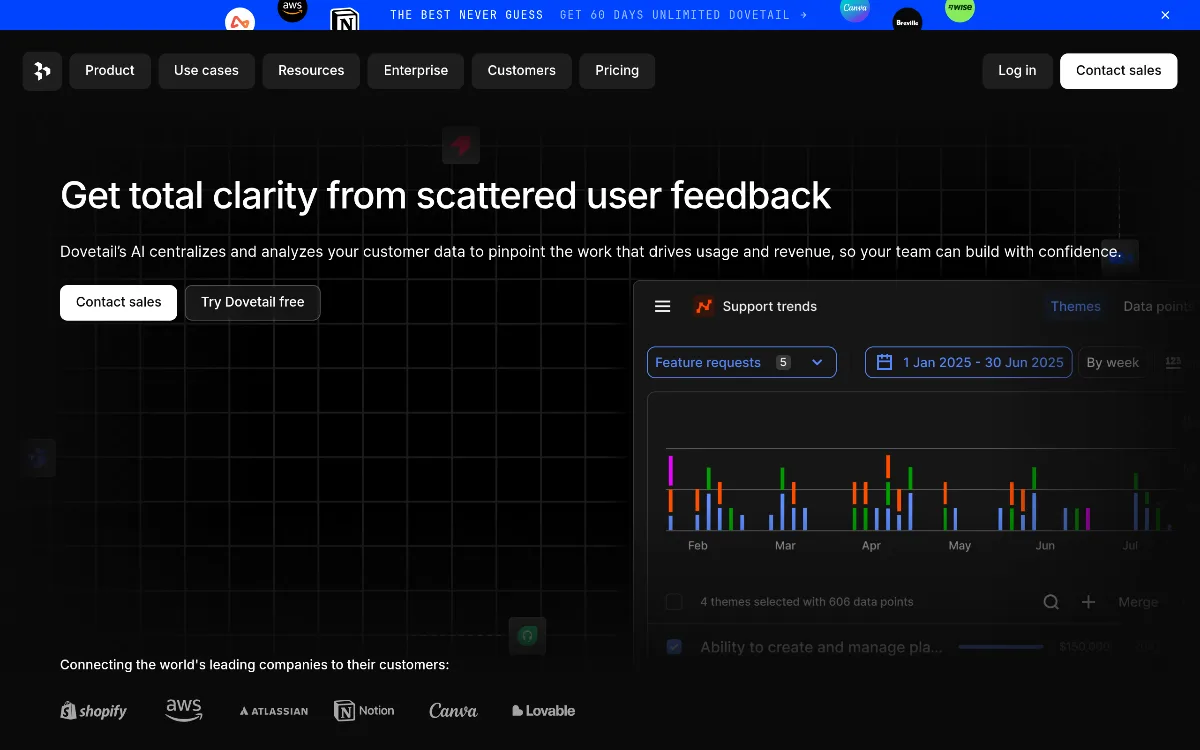
Dovetail is a Customer Intelligence Platform designed to centralize and analyze scattered user feedback. Think of it as a sophisticated brain for your organization's collective customer knowledge. It works by ingesting data from virtually anywhere—user interview recordings, support tickets, NPS surveys, and even Slack messages. Once the data is in the system, Dovetail's AI takes over to transcribe, tag, and categorize themes automatically.
The platform is built around four core pillars: Centralization, Analysis, Querying, and Automation. It allows teams to move away from fragmented Google Docs and spreadsheets into a unified library. In 2026, the standout feature is its "Query & Act" capability, which allows product managers to chat with their research data to generate Product Requirement Documents (PRDs) and prototypes instantly. This eliminates the weeks of manual synthesis that used to sit between conducting research and actually writing code.
Key Strengths
- AI-Powered Synthesis at Scale: Dovetail's AI isn't just for transcription. It identifies long-term trends and converts recurring customer themes into roadmap opportunities, saving users an average of 30 hours of manual work per week.
- Robust Security & Compliance: For enterprise users, Dovetail offers a massive advantage with its comprehensive security framework, including SOC 2 Type II, ISO 27001, HIPAA, and GDPR compliance, along with granular permission controls and data redaction.
- Seamless Discovery-to-Delivery Pipeline: The platform allows you to move from a customer interview to a generated PRD or prototype in minutes, which Dovetail claims helps teams ship 66% faster than traditional methods.
- Centralized Searchable Library: It acts as a single source of truth for product, sales, and marketing, ensuring that everyone in the company has access to the latest customer insights without needing to ask the research team for a report.
Real Use Cases
- Product Manager shipping a new feature: A PM at a company like Atlassian uses Dovetail to analyze hundreds of support tickets and feature requests to justify the next sprint, automatically generating a PRD based on real user quotes.
- UX Researcher running a study: A researcher conducts 15 video interviews, uploads them to Dovetail, and uses AI to instantly tag themes like "onboarding friction" or "pricing confusion" across all transcripts.
- Customer Success Lead identifying churn risks: The CS team connects their ticketing system to Dovetail to monitor real-time sentiment shifts, using AI agents to alert the team when a specific feature starts receiving negative feedback.
- Marketing Team refining messaging: Marketers search the Dovetail repository for the exact language customers use to describe their pain points, ensuring their website copy resonates with the target audience.
- Engineering Lead seeking context: An engineer clicks a link in a Jira ticket that leads directly to a video highlight in Dovetail, seeing and hearing the customer's frustration firsthand rather than reading a dry bug report.
Best For
- High-Growth Scale-ups: Teams that are rapidly expanding and need to ensure their product decisions are backed by data, not just intuition.
- UX Research Departments: Professionals who need a centralized home for all their qualitative data, templates, and global tags.
- Enterprise Product Teams: Large organizations like Shopify or Canva that require high-level security, MCP Server access, and complex permissioning.
- Customer-Centric Marketing Teams: Those who want to use the "voice of the customer" to drive better campaign results and brand loyalty.
Who Should Look Elsewhere
- Early-stage Indie Hackers: If you are just starting and have zero revenue, the $0 free plan's limit of one project and one channel will feel restrictive very quickly. You might be better off with simple Google Docs or Spreadsheets initially.
- Teams needing automated user testing: If you need a tool that recruits participants and runs unmoderated tests automatically, UserTesting or Luma Health (in specific niches) might be more specialized alternatives.
- Budget-sensitive SMBs: With estimated costs for 10 users reaching upwards of $14,400 annually according to some 2026 market data, smaller teams might find Usercall or similar AI-first rivals more affordable.
Limitations
- Complex Pricing Structure: The cost can escalate quickly with "extra data point" fees ($50 per 500 data points/month) and add-ons like contact segments.
- Onboarding Friction: While the tool is powerful, setup and data migration can be time-consuming, sometimes requiring professional services or onboarding fees ranging from $2,000 to $10,000 for larger teams.
- AI Oversight Required: While the AI summaries are fast, they still require human verification to ensure nuances in customer sentiment aren't missed or misinterpreted.
- Learning Curve: The sheer depth of features—global tags, fields, templates, and MCP servers—means it takes time for a team to become fully proficient.
Pricing Overview
Dovetail's pricing in 2026 is tiered to support everyone from individual researchers to global enterprises. Note that costs can vary based on the number of users and data volume.
- Free Plan ($0): Best for individuals. Includes 1 channel, 1 project, basic AI summaries, and chat capabilities for a single project. No credit card required.
- Professional Plan (Starts at ~$15-50/mo per seat): Aimed at growing teams. Supports 1-50 users, unlimited projects, unlimited channels, and advanced AI summaries. Often billed annually (approx. $180/year for basic analysis seats).
- Business Plan (Custom Pricing): For teams of 10+. Includes everything in Professional plus global tags, fields, templates, folders, and access to AI agents (currently in beta for 2026).
- Enterprise Plan (Custom Pricing): For large organizations. Includes MCP Server access, granular permission controls, data redaction, and dedicated support.
- Hidden Costs to Watch: Extra data points are billed at $50 per 500 per month. Onboarding and data migration fees may apply for enterprise tiers.
Pricing last verified: February 2026.
Our Assessment
Dovetail is no longer just a "nice-to-have" repository; in 2026, it has become a critical piece of the product development stack. The platform's greatest achievement is how it handles the "messiness" of human feedback. Most tools either give you raw data (transcripts) or high-level charts. Dovetail sits in the middle, using AI to provide the context that developers and designers actually need to build better features.
From a value-for-money perspective, the Professional plan offers the best balance for most mid-sized teams. While the Enterprise costs can look daunting—potentially exceeding $20,000 per year when including onboarding and customization—the reported 2.3x ROI suggests that the time saved (30 hours per week per user) more than offsets the subscription cost. The ease of use is high once the initial taxonomy (tags and fields) is set up, but teams should be prepared for a 1-2 week learning period to really master the automation features. If your goal is to build a truly customer-led roadmap, Dovetail is currently the most sophisticated tool to help you do it.
Top Alternatives
- Usercall — Choose Usercall when you need a more budget-friendly AI-first alternative for qualitative research.
- Spreadsheets & Notion — Choose this manual approach when you have very low data volume and cannot justify a dedicated repository cost.
- Luma Health — Choose Luma Health when your feedback needs are specifically tied to patient care and healthcare-specific EHR solutions.
Frequently Asked Questions
Q: Does Dovetail offer a free trial?
Yes, Dovetail provides a free plan ($0) that allows you to test the core features like AI transcription and project organization without a credit card. There are also trial options available for the paid Professional and Business tiers.
Q: How does Dovetail's AI save 30 hours a week?
The AI automates the most time-consuming parts of research: transcribing video calls, identifying recurring themes across hundreds of documents, and drafting initial reports or PRDs. This allows researchers to focus on strategy rather than manual data entry.
Q: Is Dovetail HIPAA compliant?
Yes, Dovetail includes HIPAA compliance as part of its security and compliance framework, making it suitable for healthcare and insurance companies that handle sensitive patient data.
Q: Can I import data from other tools?
Absolutely. Dovetail supports auto-importing data from calls, tickets, surveys, and reviews. You can also manually upload .zip files or connect via the API for custom integrations.
Q: What is the "Query & Act" feature?
This is a 2026 feature that allows you to chat with your customer data using a natural language interface. You can ask questions like "What are the top 3 complaints about our onboarding?" and Dovetail will generate a summary and a draft PRD based on the feedback in your library.
Last reviewed: February 2026. Features and pricing are subject to change — always verify on the official website.
Screenshots
 1/1
1/1Key Features
Pricing Plans
Free
$0
Professional
$15/mo per seat
Business
Custom
Enterprise
Custom
Top Dovetail Alternatives & Competitors
Explore the best similar tools and how they compare.
The AI-powered data analyst that chats with your SQL databases and spreadsheets.
User Reviews
0 reviews · 0.0 avg rating
Be the first to review Dovetail
Help the community by sharing your honest experience with this tool.
Write a Review